Navigating Insurance Requirements for Festival and Exhibition Participation
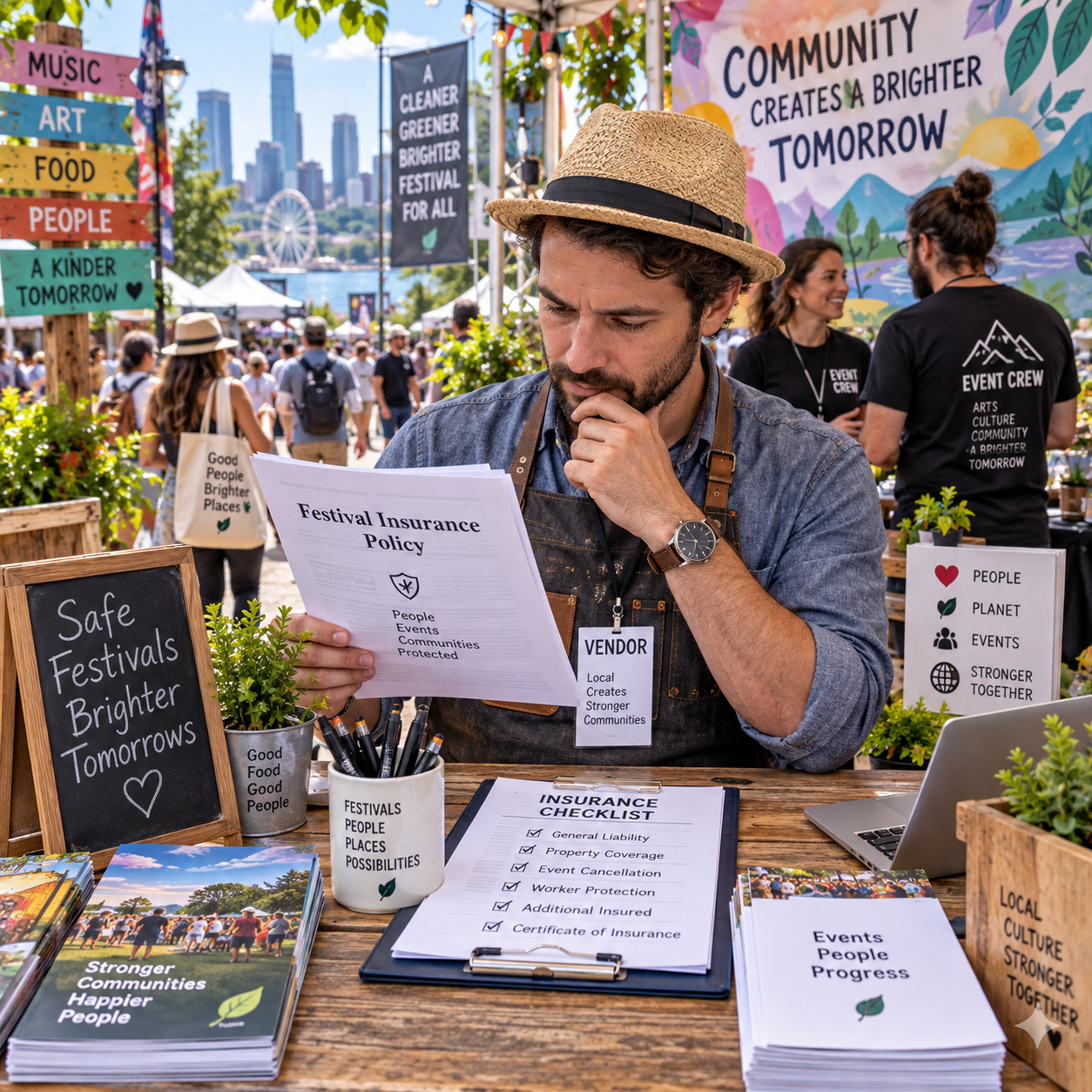
Before setting up a booth at a festival or exhibition, check what insurance the organizer requires and when they need proof. Requirements vary with the event, venue, participant’s role, and activities. A food vendor using cooking equipment, for example, may face different conditions from an artist displaying prints.
Start with the exhibitor or vendor agreement, then confirm unclear terms with the organizer and your insurer. The policy itself governs coverage; submitting paperwork alone does not guarantee that a particular risk is insured.
Why festivals and exhibitions require proof of insurance
Festivals and exhibitions request proof of insurance to help manage the costs of accidents, property damage, and other event-related claims. Requirements also help organizers confirm that participants have coverage suited to their activities and the venue’s conditions.
A crowded aisle, temporary display, electrical cable, or food preparation area can create risks for visitors, workers, and exhibitors. If a customer trips over a booth fixture or a participant damages venue property, responsibility depends on the facts, contracts, and applicable policies. Event liability insurance can help address certain claims, subject to its terms, exclusions, and limits.
For organizers, requesting insurance documentation is one part of risk management. For participants, it is a chance to identify responsibilities before arriving, when changes to a setup or policy may still be possible. Insurance does not prevent incidents, and a requirement does not mean every possible loss is covered. Read the contract and policy together, and ask questions about activities that could create unusual exposure.
Common insurance requirements for participants
Participants are commonly asked for general liability coverage, but event requirements may also involve property, equipment, or cancellation coverage. The policies that make sense depend on what you do, what you bring, and what the agreement says.
General liability coverage may respond to certain third-party claims for bodily injury or property damage connected with business activities. An organizer may specify minimum coverage limits, but there is no single limit that applies to every festival or exhibition. Check both the per-occurrence limit and any aggregate limit requested, and confirm that the policy applies to the event’s location and dates.
Other coverage may be relevant in particular situations:
- Property and equipment coverage: May help insure owned or rented displays, tools, inventory, or equipment against covered loss or damage. Check whether property is covered while in transit, at the venue, or overnight.
- Workers’ compensation: May be required by law or contract if you have employees. Requirements depend on the jurisdiction and your staffing arrangement.
- Product liability: May matter if you sell or distribute products, especially food or items that could cause injury. Confirm how your policy treats the products and sales activity involved.
- Cancellation or postponement coverage: May help with certain financial losses if a covered event disrupts participation. It is not automatic, and policy triggers and exclusions can be narrow.
Do not assume a general business policy automatically covers every event activity. Tell your insurer whether you will cook, demonstrate equipment, serve samples, sell products, or use temporary structures.
How to read the event’s insurance requirements
To read an event’s insurance requirements, compare the agreement’s limits, covered activities, named parties, dates, and submission rules with your policy. Resolve differences before you sign or arrive.
Look for exact wording in the exhibitor or vendor agreement, application, venue rules, and any insurance addendum. Requirements may be spread across several documents, so search for terms such as liability, indemnity, additional insured, certificate, and proof of coverage. Pay attention to whether the organizer asks for a specific endorsement or only a certificate of insurance.
Use this review sequence:
- Limits: Identify each required limit and compare it with your declarations page. Note whether the contract lists per-occurrence, aggregate, or other limits.
- Parties: Confirm the legal names of the organizer, venue owner, municipality, or other entities that must appear on documents or endorsements.
- Activities: Check that the policy description and coverage fit your actual booth operations, products, demonstrations, and equipment.
- Dates and location: Verify event dates, setup and teardown periods, and the correct venue address. Ask whether coverage is expected during move-in or overnight storage.
- Contract terms: Review insurance clauses alongside indemnity and responsibility provisions. They address different issues and should not be treated as interchangeable.
If a phrase is unclear, ask the organizer what document or endorsement would satisfy it, then have your insurer confirm whether it can be provided. Keep the response in writing.
Certificates of insurance and additional-insured requests
A certificate of insurance (COI) is a summary document that provides evidence of insurance at the time it is issued. It does not create coverage or change the terms of the underlying policy.
Organizers often request a COI to check the policyholder, insurer, policy dates, and stated limits. Compare those details with the event’s requirements before submission. A COI may not show every exclusion or endorsement, so it cannot answer every coverage question. If the organizer requires a specific endorsement, ask your insurer or broker for the endorsement itself or confirmation of the wording available.
An additional insured is a person or organization given certain liability protection under another party’s policy through an endorsement, subject to the policy’s terms. The organizer may request this status, sometimes along with the venue owner or a public entity. Check the exact legal names and whether the agreement specifies particular entities or wording.
Do not assume that typing an organization’s name onto a COI makes it an additional insured. The insurer generally must issue the required endorsement when the policy allows it. Ask what protection the endorsement provides and whether it is limited to liability arising from your operations. A COI and an additional-insured endorsement serve related but different purposes.
Preparing documents before the event
Prepare event insurance documents by checking the requirements early, asking your insurer to verify coverage, and submitting the correct paperwork by the organizer’s deadline. Early review leaves time to fix errors or clarify acceptable alternatives.
As soon as you receive the exhibitor materials, note the insurance documentation deadlines, required limits, named entities, and submission method. Contact your insurer or broker with the full agreement rather than paraphrasing it. Ask whether your current policy covers the event’s dates, location, and activities, and whether the requested COI or additional-insured endorsement can be issued.
Check the issued documents carefully. Confirm that names are spelled correctly, dates are current, and limits match the contract. Submit files through the method the organizer specifies, then save the documents and a record of the submission or approval. If you receive a revised contract or change your activities, recheck the insurance terms.
Allow time for the insurer to review the request; processing times vary. Avoid waiting until setup day, when correcting a certificate or obtaining an endorsement may be difficult. The organizer’s approval is useful confirmation that paperwork meets its stated process, but it does not replace your own review of policy coverage.
What to do if your coverage doesn’t meet the requirements
If your coverage does not meet the event’s requirements, contact both the organizer and your insurer before participating. Ask what options are acceptable, and do not assume a certificate can correct a policy gap.
First, identify the specific mismatch: a low limit, missing additional-insured status, an excluded activity, a policy date issue, or a document deadline. Then send the organizer the relevant contract wording and ask whether it will accept an alternative, such as a different endorsement or other evidence of coverage. Get any exception in writing.
Ask your insurer or broker whether an endorsement, policy change, or separate event policy is available and what it would cover, cost, and exclude. A change may address one requirement while leaving other exposures untouched. For example, increasing a liability limit does not automatically insure booth inventory or rented equipment. Confirm the effective date before relying on any change.
If no acceptable option is available, consider whether you can modify the activity or choose not to participate. The right decision depends on the contract, policy, and your risk tolerance. Avoid making assurances about coverage that your insurer has not confirmed.
A practical pre-event insurance checklist
Before the event, confirm that your policy matches the organizer’s written requirements and that the required documents have been accepted. Keep copies accessible during setup and throughout the event.
- Read the complete exhibitor or vendor agreement, insurance addendum, and venue rules.
- Confirm required policy types, coverage limits, event dates, location, and covered activities.
- Check whether an additional-insured endorsement is required and verify every entity’s legal name.
- Review property and equipment needs, including transit, storage, and rented items.
- Ask your insurer or broker about exclusions, endorsements, and any activity that falls outside your usual operations.
- Submit the COI and required endorsements by the stated deadline, using the requested method.
- Save the submitted documents, written clarifications, and organizer approval.
- Recheck coverage if the event dates, booth setup, staffing, or activities change.
Requirements differ from one event to another, so treat this list as a final check rather than a substitute for the contract or policy. When a term remains uncertain, get a clear answer from the organizer and your insurer before you commit to participating.